In short
The challenge: New Zealand’s rapid IT growth and rising demand for tech talent are colliding with persistent skills shortages and misconceptions about the sector. Many potential jobseekers or career changers hesitate to enter IT because they fear they lack the right skills or don’t fit industry stereotypes, leaving businesses struggling to fill critical roles while individuals risk missing out on future-proof opportunities.
The solution: Career opportunities in information technology are expansive. The sector offers jobseekers and career changers a future-proof pathway with high demand, strong salaries, flexibility, and diverse roles. Pursuing a career in information technology provides stability, growth opportunities, and the chance to build meaningful, impactful work in a thriving industry.
The result: There are abundant, flexible, and well-paid opportunities in IT that offer long-term stability and creative problem-solving potential.
With over a decade of experience in the staffing and consulting industry, Ronil Singh is a Senior Leader known for his strong business acumen and proven ability to match jobseekers with New Zealand businesses.
He brings extensive knowledge across most facets of recruitment, specialising in permanent, interim, and consulting roles within the finance and technology verticals. His dedication to delivering excellence in talent acquisition has established him as a trusted leader in the industry, committed to driving business growth and fostering strong relationships with clients and stakeholders alike.
Throughout his career, Ronil has focused on providing timely and commercially viable solutions, ensuring excellent service delivery that enhances client retention and profitability. His expertise extends to managing multi-disciplinary recruitment teams across all levels of the business, including Executive-level talent acquisition.
Why IT?
New Zealand’s tech sector is rising as a growth engine. It contributed $23.8 billion to GDP in 2024, making up 8 percent of the economy and ranking among the country’s top exports. Despite recent hiring slowdowns, firms are beginning to reinvest in digital transformation projects, especially in cloud, cybersecurity, and data analytics.
As a nation, we are quite tech savvy. Kiwis are strong digital adopters, and our government supports further innovation through strong incentives.
Every day I see just how talented and diverse our tech workforce is - it’s little surprise that there is a plethora of career options in the IT field.
If you’re interested in exploring what IT has to offer, you should be.
Let’s take a look at what makes IT so alluring for graduates and career changers alike:
1. Industry growth
The latest findings from DLA Piper’s 2024 Tech Index Report reveal that New Zealand’s tech sector remains resilient and poised for growth despite global geopolitical and regulatory challenges.
The report, which surveyed 1,200 decision-makers from tech organisations worldwide, including executives from the Asia Pacific region, highlights key opportunities in Artificial Intelligence (AI) and a cautious optimism across the industry. In New Zealand, this optimism is mirrored by a strong focus on AI as a pillar of future success, despite challenges related to data privacy, security, and regulatory compliance.
This growth is only expected to continue, given IT’s critical role in addressing major national challenges.
2. Demand
Modern businesses face a wide range of IT-related challenges.
According to NZTech’s 2024 metrics, the tech sector employed about 119,520 people, representing ~4.8% of New Zealand’s workforce.
These days, organisations have a lot to consider and manage daily: persistent skills shortages, rapid technological advancements, economic uncertainties, and evolving cybersecurity threats.
Today, more than ever, leaders want to know they have the best IT talent protecting and building their business.
This has boosted the demand for skilled IT professionals in New Zealand.
As outlined in the Robert Half New Zealand Salary Guide, businesses are specifically looking for:
Cloud integration experts – As companies increasingly migrate to cloud-based software solutions. IT contractors – To deliver on critical projects and address acute business demands without long-term financial commitment. Specific IT positions – Roles Senior Software Developer, DevOps Engineer, Security Engineer, Systems Engineer and IT Support are in hot demand as businesses strive to be agile and ahead of the curve.
These roles are highly specialised and generally require university qualifications (as well as at least three years of experience for some roles).
In my opinion, herein lies the issue for Kiwi businesses.
The nation is set to struggle to meet the short-term demand for these roles (especially with few workers in other parts of the labour market with similar skills and experience).
The answer? Aside from skilled migration, New Zealand needs a stronger pipeline of graduates (and career changers) to meet demand.
This is certainly set to boost career options in the IT field.
3. Salary range
If you’re seeking financial independence, look no further than IT.
It is certainly an attractive field - not only due to rapid growth and innovation, but also because of the exciting earning potential it offers.
New Zealand boasts a wide range of career options in the IT field, and the salary range is no different.
IT professionals can expect to enjoy competitive salaries across a variety of different roles.
The Robert Half New Zealand Salary Guide outlines all the salary benchmarks based on comprehensive placement data.
The guide explores the functional areas within IT and technology where businesses are most likely to hire.
This strong salary range has proved to be a key motivator for jobseekers and career changers alike. With demand for these roles so high, it can be a lucrative pathway towards a future-proofed career.
Related: How to negotiate a cyber-security salary in NZ
4. Flexibility
Building a meaningful career doesn’t just hinge on professional accomplishments - an enriching employee experience is also vital.
With 55% of tech workers saying their employer has increased flexible work hours compared to the last 12 months*, it’s clear that IT offers a good degree of flexibility.
Many career options in the IT field support hybrid or remote work, flexible hours, and project-based arrangements.
This is an attractive prospect, particularly for professionals wanting to achieve a more positive work-life balance.
5. The 'future-proof' factor
Tech jobs are some of the most well-paid, secure and flexible jobs in the country. New Zealand has seen a rapid rise in tech jobs since the early 2000s.
It’s little surprise that IT is one of the most future-proof career paths available.
As technology continues to drive innovation across Kiwi industries, demand for IT professionals shows no signs of slowing down (especially in areas like cloud computing, data analytics, cybersecurity, and software development).
Make no mistake, career options in the IT field come with high demand, long-term stability, growth opportunities, and plenty of prospects.
6. Creative problem solving
Some of the biggest misconceptions about IT roles are that they are ‘boring’ and ‘purely technical’.
If you’re a jobseeker or career changer, know this is far from true.
It isn’t just about coding or systems - career opportunities in information technology offer many outlets for creative problem-solving.
These professionals are consistently challenged to think outside the box to find innovative solutions.
Examples include:
Designing smarter business systems to improve efficiencyDeveloping apps, platforms, or tools to solve genuine problemsTransforming large, messy datasets into clear insights
Creativity is at the heart of solving the tech problems impacting real businesses and people (it’s what makes it so rewarding, too!)
If you thrive on thinking differently, adapting quickly, and designing high-impact solutions, IT could be the field for you.
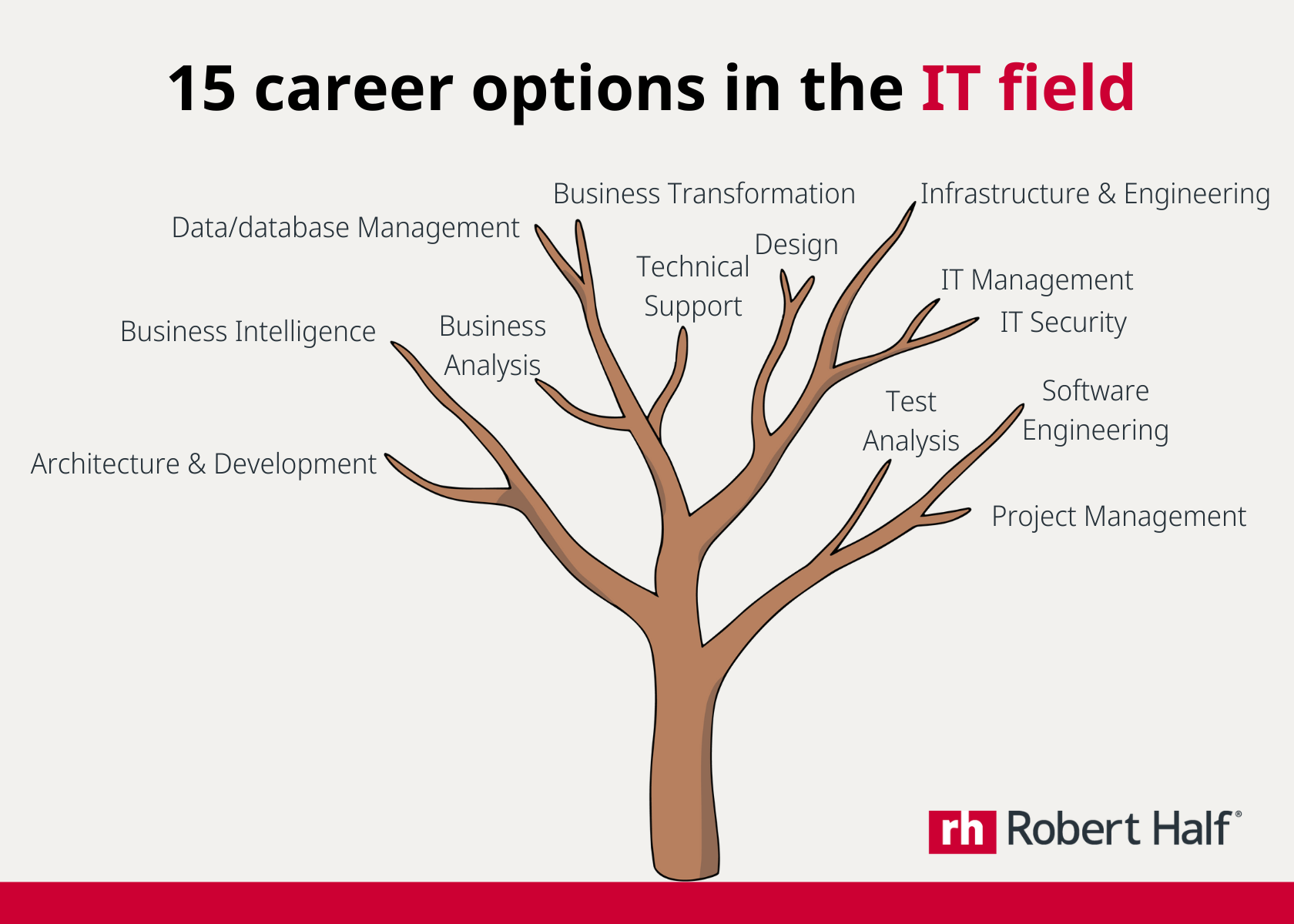
15 career options in the IT field
The breadth of career options in the IT field cannot be understated.
The roles within this industry are vast, with something to suit different qualifications, values, and goals.
Unsure where you might fit?
Consider whether any of these areas align with your personal aspirations.
1. Architecture and Development
Architecture and development encompasses the processes of designing, building, and maintaining the systems, applications, and infrastructure that power a business’s technology.
It combines high-level planning (architecture) with hands-on coding and implementation (development) to deliver scalable, secure, and efficient digital solutions.
Relevant roles include:
Infrastructure ArchitectSolutions ArchitectStaff EngineerEnterprise ArchitectData Architect
2. Business Intelligence
Business intelligence (BI) is the process of collecting, analysing, and visualising data to drive informed decision-making.
It translates raw data into actionable insights through dashboards, reports, and analytics tools, enabling businesses to identify trends, opportunities, and areas for improvement.
Relevant roles include:
Business Intelligence AnalystBusiness Intelligence DeveloperBusiness Intelligence Manager
3. Business Analysis
Business analysts act as a bridge between stakeholders and technical teams, ensuring systems, processes, and software align with business goals and deliver measurable value.
The practice of business analysis helps to identify business needs and translate them into clear requirements for technology solutions.
Relevant roles include:
Business AnalystSenior Business Analyst
4. Data/Database Management
Data and database management involve storing, organising, and maintaining data in a way that it is accurate, secure, and accessible when required.
It allows businesses to reliably use their data for operations, reporting, and decision-making through well-structured databases and governance practices.
Relevant roles include:
Database AdministratorData Warehouse Consultant
5. Technical Support & Operations
Technical support & operations professionals are focused on keeping technology systems running smoothly by troubleshooting issues, maintaining infrastructure, and supporting end users.
This paves the way for minimal downtime, reliable performance, and quick resolution of technical problems to optimise business performance.
Relevant roles include:
IT Support Level 1IT Support Level 2Systems AdministratorApplication Support
6. Infrastructure and Engineering
This area of IT focuses on designing, building, and maintaining the core technology systems that keep a business running (I.e., networks, servers, and cloud environments).
It focuses on creating secure, scalable, and reliable foundations to support applications, data, and business users.
Relevant roles include:
Network EngineerSenior Network EngineerSystems EngineerSenior Systems EngineerInfrastructure ManagerCloud EngineerDevOps Engineer
7. IT Management
IT management oversees the planning, implementation, and maintenance of an organisation’s technology strategy and systems.
It ensures that IT resources, projects, and teams are aligned with business goals, delivering secure, efficient, and cost-effective solutions.
Relevant roles include:
IT managerSoftware Development ManagerChief Information OfficerProgram Manager
8. IT Security/Cyber-Security
IT security professionals work to protect systems, networks, and data from unauthorised access, attacks, and breaches.
This field involves implementing tools, policies, and processes to safeguard information and ensure business continuity in an increasingly digital world.
Relevant roles include:
Security AnalystSecurity EngineerSecurity Architect
9. Test Analysis
This function ensures software, systems, and applications work as intended before launching.
These professionals work to systematically find and fix bugs, verify performance, and maintain high standards to deliver reliable, user-friendly technology solutions.
Relevant roles include:
Manual Test AnalystSenior Manual Test AnalystAutomation Test AnalystSenior Automation Test AnalystTest Manager
10. Software Engineering
This discipline involves designing, developing, testing, and maintaining software applications and systems to meet specific business or user needs.
Leaning on the principles of computer science, engineering, and project management, it creates reliable, efficient, and scalable software solutions.
Relevant roles include:
Junior Software EngineerIntermediate Software EngineerSenior Software EngineerTechnical Lead - Software Engineering
11. Software Development
Software development is the process of designing, building, testing, and maintaining computer applications, systems, and programs that solve problems or improve efficiency. It involves translating user needs into functional digital solutions through coding, system design, debugging, and continuous improvement.
Developers often work collaboratively across stages such as planning, programming, quality assurance, and deployment, using languages like Python, Java, or C#. In New Zealand, software development spans diverse sectors, from finance and government to agritech and healthtech, driving innovation, automation, and digital transformation across the economy.
Relevant roles include:
Software DeveloperSenior Software Developer
12. Design
Design refers to the process of planning and creating the structure, interface, and user experience of software applications or digital systems.
The goal is to make technology intuitive, visually appealing, and functional while meeting user and business goals.
Relevant roles include:
Product DesignerSenior Product Designer
13. Project Management
Project management is the practice of planning, executing, and overseeing technology projects to ensure they are completed on time and within budget.
Project management professionals in IT work to coordinate resources, manage risks, and align project goals with business objectives.
Relevant roles include:
Project ManagerSenior Project Manager
14. Product Management
Product management is the strategic function responsible for guiding a product’s development, launch, and lifecycle to meet both customer needs and business goals. It sits at the intersection of technology, business, and user experience, ensuring alignment between what a company builds and what the market demands.
Product managers define the product vision and roadmap, gather and prioritise requirements, collaborate with engineering, design, marketing, and sales teams, and measure success through data and customer feedback. In essence, they act as the bridge between strategy and execution, turning ideas into tangible products that drive value and growth.
Relevant roles include:
Product OwnerProduct ManagerSenior Product ManagerHead of Product
15. Business Transformation
In IT, business transformation is the process of leveraging technology to fundamentally overhaul how an organisation operates, delivers value, and engages with customers.
It involves adopting new digital tools, processes, and strategies to improve efficiency, innovation, and general business performance.
Relevant roles include:
ERP Functional ConsultantERP Technical Consultant
Pursuing career options in the IT field
Explore IT jobs
Like the sound of some of these roles?
With the right action plan, the appropriate skills, and a positive mindset, these positions (and more) are achievable.
Wondering how to get started?
1. Focus on upskilling
Start with beginner-friendly, role-specific learning paths (i.e., coding, cybersecurity, or data analysis).Get hands-on experience to ‘learn by doing’ (i.e., immersion in projects or contributing to open-source work). Join communities to share challenges and insights (i.e., industry groups and online networks). Take inspiration from role models who’ve made the switch. Don’t wait to be perfect! Apply what you know and use every project as a chance to grow.
2. Cultivate the right mindset
Make no mistake, mindset matters.
Sure, starting an IT career can feel intimidating, but if you’re worried about any of the below, you shouldn’t be:
Misconceptions – “You work alone behind a screen all day.”Stereotypes – “I’d have to be a ‘tech genius’ to work in IT.”Imposter syndrome – “Everyone else is smarter and more tech savvy than me.”Age – “I’m too old to move into technology.” Learning curves – “I’ll never keep up with technology – it changes too often.”
Do away with the negative talk and focus on positive steps forward it’s about progress, not perfection. IT is a space that embraces all ages, backgrounds, and qualifications - it’s an industry that rewards curiosity, persistence, and an appetite for learning.
With more growth on the cards for this burgeoning industry, now is the time to consider career options in the IT field.
Whether you’re a graduate or a career changer, the future looks bright in this fast-evolving, high-demand field.
What are you waiting for? Get in touch, and let my team help you find the latest career opportunities in IT.
*Source: The study is developed by Robert Half and was conducted online in November 2024 by an independent research company among 500 full-time office workers in finance, accounting, and IT and technology. Respondents are drawn from a sample of SMEs as well as large private, publicly-listed and public sector organisations across New Zealand. This survey is part of the international workplace survey, a questionnaire about job trends, talent management, and trends in the workplace.
Frequently Asked Questions (FAQs)
Which career is best for information technology in New Zealand right now?
The Robert Half 2025 New Zealand Salary Guide highlights what IT positions businesses are currently looking for:
Cloud integration experts – As companies increasingly migrate to cloud-based software solutions. IT contractors – To deliver on critical projects and address acute business demands without long-term financial commitment. Specific IT positions – Roles including Business Analyst, Data Engineer, and Systems Engineer are in hot demand as businesses strive to be agile and ahead of the curve.
What qualifications and education do I need for an IT career in New Zealand?
While specific requirements vary between job roles, the below serves as a general guide for many positions.
University Degrees - A bachelor’s degree in Information Technology, Computer Science, Software Engineering, or Cybersecurity is a common pathway for many IT roles.
Vocational Education - ITPs and registered training organisations offer diplomas and certificates in areas like Networking, Web Development, or IT Support.
Industry Certifications - some popular certifications in New Zealand include CompTIA A+ or Network+ (entry-level IT knowledge), Cisco CCNA (networking), AWS/Azure certifications (cloud computing), and Certified Information Systems Security Professional (CISSP) for cybersecurity.
What is the highest-paid IT career in New Zealand?
According to the Robert Half 2025 New Zealand Salary Guide, the area of IT Management commands some of the highest salaries.
A Chief Information Officer role commands up to $350,000.
What are some career opportunities in technology in New Zealand?
Some exciting career opportunities include:
Architecture and DevelopmentBusiness IntelligenceBusiness AnalysisData/Database ManagementTechnical Support & OperationsInfrastructure and EngineeringIT ManagementIT Security/Cyber-Security Test AnalysisSoftware EngineeringSoftware DevelopmentDesignProject ManagementProduct ManagementBusiness Transformation