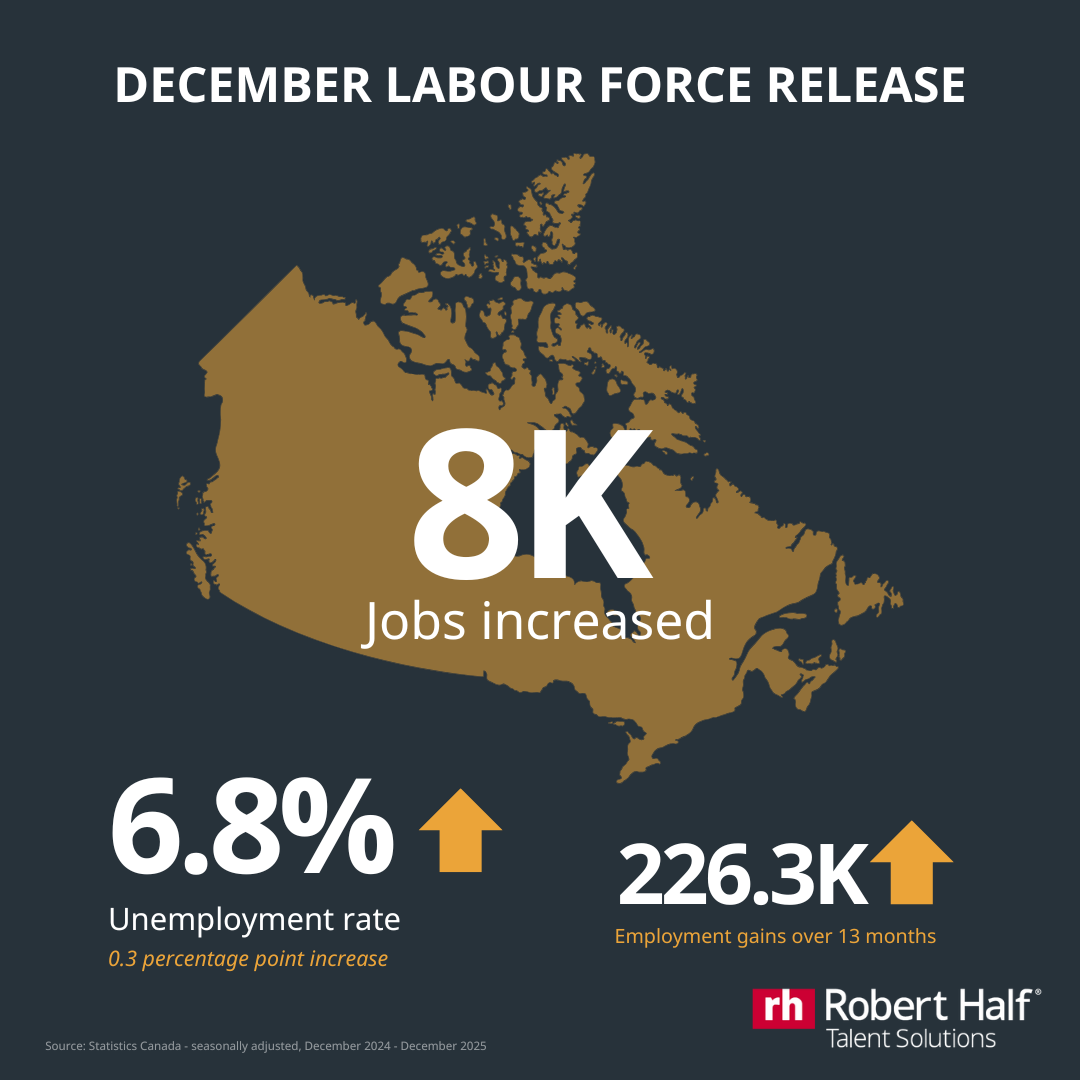
The latest Statistics Canada Labour Force Survey for December 2025 reveals little change in Canada's job market, as employment grew by 8,200 (+0.0%).Statistics Canada’s latest Labour Force Survey reports that the Canadian unemployment rate increased by 0.3 percentage points to 6.8 per cent in December 2025. The employment rate held steady at 60.9 per cent. Year-over-year, employment was up by 1.1 per cent, with approximately 226,300 more people working in December 2025 compared to December 2024.
December Labour Force Release
8,200 jobs increased
6.8% unemployment rate (0.3 percentage point increase)
226,300 employment gains over 13 months
Source: Statistics Canada - seasonally adjusted, December 2024 - December 2025
Employment patterns once again shifted in the last month of 2025, with gains in some sectors and declines in others. The largest increase, for the second consecutive month, was recorded in health care and social assistance, which added 21,000 jobs (+0.7 per cent). The 'other services' sector such as personal and repair services, also added 15,000 jobs in December (+2.0 per cent). Other industries that reported job gains in December 2025, according to Statistics Canada, include:Construction: +11,200 (+0.7 per cent)Educational services: +10,500 (+0.7 per cent)Public administration: +6,700 (+0.5 per cent)Manufacturing: +4,300 (+0.2 per cent)Agriculture: +1,300 (+0.6 per cent)Business, building and other support services: +700 (+0.1 per cent)*‘Other services’ includes businesses and organizations providing services not covered by other sectors.At the same time, fewer people were employed in professional, scientific and technical services (-18,000; -0.9%), accommodation and food services (-12,000; -1.0%), and utilities (-5,300; -3.0%). Other industries that reported job losses in December 2025, according to Statistics Canada, include:Finance, insurance, real estate, rental and leasing: -10,200 (-0.7 per cent)Wholesale and retail trade: -5,600 (-0.2 per cent)Utilities: -5,300 (-3.0 per cent)Information, culture and recreation: -4,200 (-0.5 per cent)Transportation and warehousing: -3,400 (-0.3 per cent)All percentages above represent MoM change
Canada’s unemployment rises in December 2025
Statistics Canada’s December 2025 Labour Force Survey reported that Canada’s national unemployment rate increased by 0.3 percentage points from November to December to 6.8 per cent. For businesses seeking to navigate this evolving labour market landscape, these statistics offer valuable insights for workforce planning and recruitment strategies for 2026.While the job market in Canada continues to fluctuate across many sectors, the unemployment rates for skilled professionals supported by Robert Half Canada’s staffing experts – continue to be below the national average:Business, finance and administration occupations, which includes finance and accounting, HR, and administration and customer service roles: 3.2 per cent (2.9 per cent in November 2025)Natural and applied sciences and related occupations, which includes technology roles: 3.1 per cent (3.2 per cent in November 2025)Management occupations, which includes marketing and creative roles: 2.0 per cent (2.1 per cent in November 2025)Occupations in education, law and social, community and government services, which includes legal roles: 1.9 per cent (2.1 per cent in November 2025)Customer support roles, which fall outside the above Statistics Canada categories:3.8 per cent (4.0 per cent in November 2025)
Provincial unemployment breakdown December 2025
Unemployment rates by province:British Columbia: 6.4 per cent (no change from November 2025)Alberta: 6.8 per cent (6.5 per cent in November 2025)Saskatchewan: 6.5 per cent (5.6 per cent in November 2025)Manitoba: 5.7 per cent (6.1 per cent in November 2025)Ontario: 7.9 per cent (7.3 per cent in November 2025)Quebec: 5.4 per cent (5.1 per cent in November 2025)New Brunswick: 6.6 per cent (no change from November 2025)Prince Edward Island: 7.3 per cent (7.7 per cent in November 2025)Nova Scotia: 6.5 per cent (6.7 per cent in November 2025)Newfoundland and Labrador: 10.7 per cent (10.4 per cent in November 2025) The December 2025 Labour Force Survey continues to reflect a shift in provincial labour markets, with rates easing in some areas (Manitoba, Prince Edward Island, and Nova Scotia) and rising in others (Alberta, Saskatchewan, Ontario, Quebec, and Newfoundland and Labrador).Employment trends varied across Canada in December. Despite the national unemployment rate increasing by +0.3 per cent to 6.8 per cent, employment was up in Quebec (+16,000; +0.3%) while it fell in Alberta (-14,000; -0.5%) and Saskatchewan (-4,000; -0.6%). There was little employment change in the other provinces.All percentages above represent MoM changeThis varying provincial performance underscores the complexity of Canada’s labour market, where regional economic factors, trade dynamics, and sector-specific trends continue to shape employment outcomes.Read Robert Half Job Market Updates to get a full picture of Canada’s Labour Force:2025 Canada Job Market: November Labour Force Survey2025 Canada Job Market: October Labour Force Survey2025 Canada Job Market: September Labour Force Survey
Employer and worker confidence
While many of the Canada job market’s latest numbers continue to indicate a challenging economic climate, the unemployment rates for skilled professionals remain steady which align with Robert Half Canada’s latest Demand For Skilled Talent report. The research found that more than half – 58 per cent – of Canadian companies surveyed planned to add new permanent positions in the second half of 2025, while another 36 per cent planned to fill vacated positions. Nearly 7 in 10 business leaders are increasing the number of contract professionals they enlist to support new projects during the same period. The research also reveals, 82 per cent or more (percentage varies depending on the profession) of hiring managers reported challenges finding skilled talent in this current market.While many of the Canada job market’s latest numbers continue to indicate a challenging economic climate, the unemployment rates for skilled professionals remain steady which align with Robert Half Canada’s latest Demand For Skilled Talent report. For organizations seeking to hire skilled professionals, the message is clear: Competition for top talent remains and is likely to continue throughout 2026. That’s why companies are responding by offering the following:Work-life balance (e.g., hybrid work) (52 per cent)Financial benefits (e.g., bonuses) (51 per cent)Retirement benefits (43 per cent)Health and wellness programs (39 per cent)Data from the new 2026 Canada Salary Guide From Robert Half
Numbers you can count on
Get the ReportOur latest Demand for Skilled Talent report provides Canadian employers with the latest employment trends and challenges across six professional fields: finance and accounting, technology, marketing and creative, legal, administrative and customer support, and human resources.
Access the GuideThe 2026 Canada Salary Guide From Robert Half covers Canadian hiring and compensation trends across the six fields as well, incorporating exclusive data and input from surveys of thousands of Canadian workers and hiring managers, along with salary information for professionals we’ve matched with employers across the country.Whether you’re launching a job search, actively hiring talent or developing a staffing strategy for your business, there’s no better source of insights into today’s salary and compensation trends than the 2026 Canada Salary Guide From Robert Half.