Your team is one of the first and most complex of its kind in the history of work. It has the potential to span all five generations currently in the workplace, each uniquely moulded by the society in which it was forged. Learn to manage this multi-generational workforce effectively, and you’ll unlock all the benefits of generational diversity: enhanced problem solving, grounded decision-making, and increased productivity.
Robert Half finance and accounting practice manager and Generations in Collaboration board member David Belsher reveals the root of generational conflict at work and five ways to foster effective collaboration.
Meet the five generations in the workplace
The five generations in today’s workforce span 83 years, from oldest to youngest. Each generation’s communication style, professional values, and preferred leadership style have been shaped by the culture they grew up in.
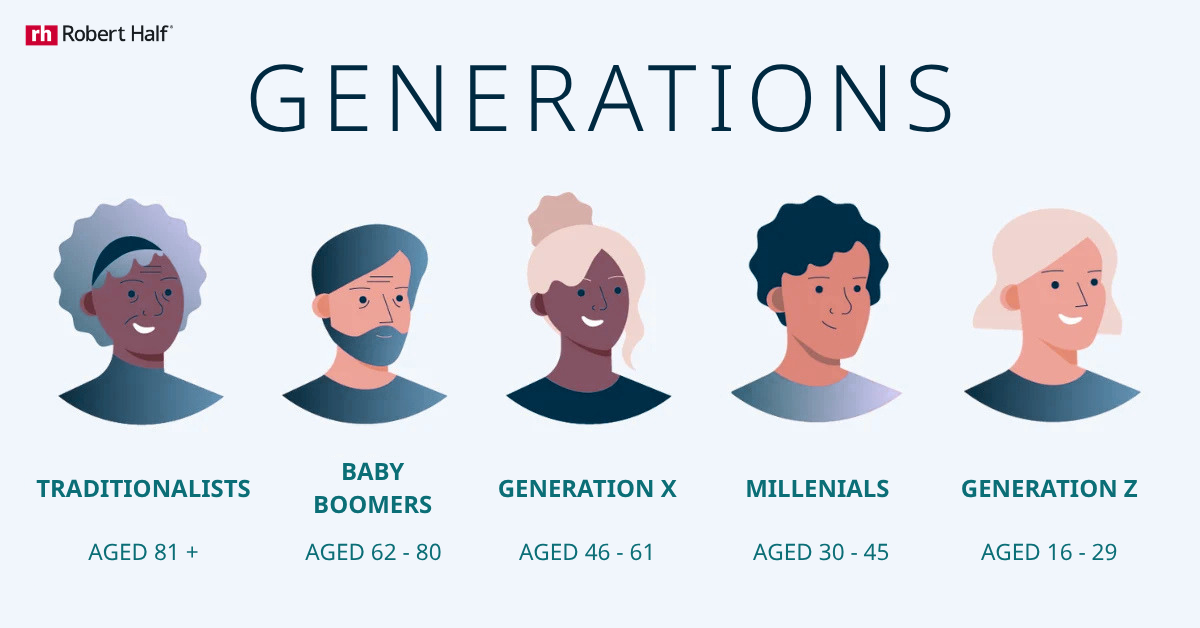
Traditionalists (1928 - 1945)
Aged from 98 to 81 in 2026
Traditionalists (also known as the ‘silent’ generation) are the oldest generation in the workforce today. They were raised during World War II and are often characterised as loyal, long-tenured workers. They value monetary rewards, are motivated by the prospect of rising through the ranks and often view work as their duty.
Baby Boomers (1946 - 1964)
Aged from 80 to 62 in 2026
Baby Boomers are named for the ‘boom’ in birth rates post-World War II. They are typified by their confidence, independence, and willingness to assert authority. Baby Boomers thrive in structured work environments with clear role remits and are incentivised by benefits like pension support and life cover.
Generation X (1965 - 1980)
Aged from 61 to 46 in 2026
Generation X is the first generation to be raised with two working parents; as a result, they’re often considered to be self-reliant with a strong work ethic. Gen X thrive when given clear development pathways and is ideally placed to facilitate cross-generational collaboration.
Millennials (1981 - 1996)
Aged from 45 to 30 in 2026
Millennials grew up alongside emerging technology and are considered the first ‘digital generation’. According to Deloitte UK's 2026 Gen Z and Millennial Survey, work-life balance outstrips financial independence and career progression as a top career goal for Millennials.
Generation Z (1997 - 2010)
Aged from 29 to 16 in 2026
Generation Z are digital natives and have never known a world without the internet. In the workplace, they want managers who act as mentors rather than task supervisors - Deloitte's Gen Z and Millennial Survey found that 86% want guidance and inspiration from their managers.
What causes generational differences in the workplace?
In many cases, assumptions built on unconscious biases are at the root of generational conflicts in the workplace. Learning to challenge these is the first and most important step in managing multi-generational teams smoothly.
David says, “I think what causes [conflict] are the labels that we put on generations and the assumptions that we get through those labels. There is that media-driven assumption that then comes through into the workplace that causes you to assume that a certain generation is going to have a certain mindset.”
How managers can lead multi-generational teams effectively
1. Treat workers as individuals
Not every generation is a monolith, nor is every employee a generational stereotype. The first challenge managers must overcome to reap the myriad benefits of a multi-generational workforce is to treat each employee as an individual.
“Don’t assume that if someone's Gen Z, for example, they're going to react any differently to somebody who's a Millennial,” says David. “It’s about trying to find out what makes that particular person tick.”
2. Relay the message three ways
David recommends delivering the same message in three ways - face-to-face, in a group meeting, and in writing - to ensure it’s clearly received. Although David says this is just good business communication, it can also be helpful in a multi-generational setting. He says:
“When you're communicating with anybody in any business, you try to get the point across. Some people would hear that communication verbally; some people pick it up via email; and some people pick it up via video. It’s standard stuff, but some people assume that certain generations communicate in different ways and prefer different ways.”
3. Prioritise regular career check-ins for all generations
Age or generation hold very little bearing on an individual’s career path - older generations may not want to stay put or wind down, just as younger generations might be hungrier than stereotypes would have you believe. David advises asking these questions regularly to help keep the workforce happy and fulfilled.
“You should be doing a weekly or bi-weekly catch-up and saying, ‘Where are you at this point in your career?’” He says. “It bubbled up from a conversation [Robert Half’s Generations in Collaboration board] had a few times about people looking at their job, not getting what they want, and then looking to move on, and it comes as a surprise to whoever's in charge of those people.”
Read: Generations at work – Why inclusive meetings are more productive
4. Facilitate knowledge transfer
Employee network groups, group forums, and reverse mentorship initiatives are all excellent ways to encourage the various workplace generations to share knowledge and produce fresh ideas. It can extend beyond workplace support to the various life stages an individual may experience that affect their approach to work, such as buying a home, caring for an elderly parent, or having children. David says:
“Make use of the generations, make use of the knowledge and the skills and the attitude of people, and make sure that you've got that whole skill set and whole bag of knowledge in your team to share and ultimately - from a work perspective - make people learn and grow, and if it helps them outside of work, then that's an absolute bonus as well.”
Read: Productivity in a multi-generational workforce – how to foster better collaboration
5. Adopt a flexible approach
Flexible work options are among the most popular benefits employees look for when choosing an employer. And, when you consider this within the context of a multi-generational team, it makes sense. Each generation has a different lifestyle, work style, and differing obligations and priorities in life - flexible working ensures they have the balance needed to truly show up.
Read: the benefits and perks employees want most in 2026
“Don't accept stereotypical notions that certain generations want to be in the office five days a week and certain generations want to be out of the office five days a week. The headline about this is: don't stereotype. Get to know the individual. Find out what makes them tick, what they want, and avoid stereotyping. Think about who's on your team and make sure it works for them,” David says.