Qualified tech talent is currently in short supply but high demand. Large-scale transformation initiatives, combined with a need for stronger tech foundations and strategic growth, have driven salary premiums above market value as businesses compete for talent capable of delivering.
According to data collected for our 2026 Salary Guide, 70% of IT and tech hiring managers said they were willing to pay higher salaries to professionals with niche skills like cybersecurity, cloud and machine learning.
Whether you’re an employer or a professional, staying on top of current hiring trends and market developments can be all it takes to gain the competitive edge.
Our tech and IT recruiters have pulled fresh hiring data to help build a picture of demand across roles, where hiring pressure is building, and seasonal hiring patterns to help you stay on top.
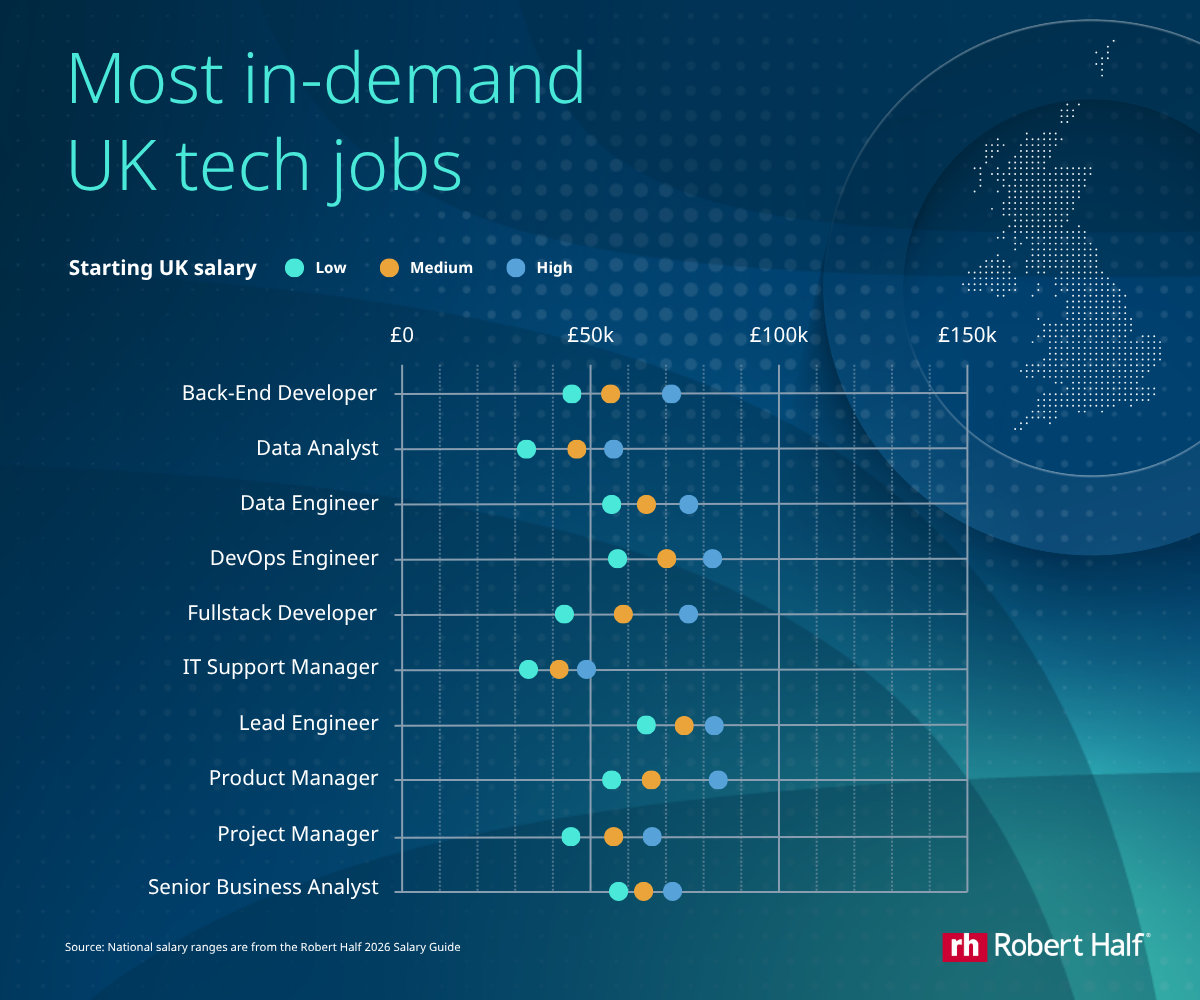 Horizontal salary chart titled: “Most in-demand UK tech jobs” showing low, medium and high starting salary ranges based on the Robert Half 2026 Salary Guide.
Back-End Developer: £45k low, £55k medium, £70k high.
Data Analyst: £33k low, £46k medium, £56k high.
Data Engineer: £55k low, £65k medium, £75k high.
DevOps Engineer: £57k low, £69k medium, £81k high.
Fullstack Developer: £43k low, £58k medium, £75k high.
IT Support Manager: £33k low, £42k medium, £49k high.
Lead Engineer: £65k low, £74k medium, £81k high.
Product Manager: £55k low, £66k medium, £83k high.
Project Manager: £44k low, £56k medium, £67k high.
Senior Business Analyst: £57k low, £64k medium, £70k high.
Source: National salary ranges are from the Robert Half 2026 Salary Guide.
Horizontal salary chart titled: “Most in-demand UK tech jobs” showing low, medium and high starting salary ranges based on the Robert Half 2026 Salary Guide.
Back-End Developer: £45k low, £55k medium, £70k high.
Data Analyst: £33k low, £46k medium, £56k high.
Data Engineer: £55k low, £65k medium, £75k high.
DevOps Engineer: £57k low, £69k medium, £81k high.
Fullstack Developer: £43k low, £58k medium, £75k high.
IT Support Manager: £33k low, £42k medium, £49k high.
Lead Engineer: £65k low, £74k medium, £81k high.
Product Manager: £55k low, £66k medium, £83k high.
Project Manager: £44k low, £56k medium, £67k high.
Senior Business Analyst: £57k low, £64k medium, £70k high.
Source: National salary ranges are from the Robert Half 2026 Salary Guide.
Tech jobs in the UK: market update
Hiring remains strong
Hiring for 2026 was slow to start, with all professional services sectors (e.g. finance, administrative) posting YoY declines. However, large-scale transformation projects and the threat of increasingly complex cyberattacks have continued to drive demand for tech and IT professionals, who experienced the smallest decline of all professional services sectors at 16%.
The biggest talent gap is operational
Although the tech and IT sector has consistently shown strong demand for talent capable of exploiting new technologies for speed and capability, the latest data has also revealed an operational talent gap for tech implementation, with demand for roles in digital transformation project services — namely project managers — rising in recent months.
Beat the competition with better benefits
Employers are offering premium salaries to talent with the niche skills needed to support large-scale transformation, but for today’s professionals, salary is only part of the story. Rising demand for more flexible working options as standard, clear progression pathways, and tailored offers are more likely to attract the best talent and keep them for long-term careers in technology.
Top 10 most in-demand roles in tech
Project Manager: As the highest-volume role overall, with consistently elevated hiring throughout the full period, the importance of an IT and tech project manager for smooth, on-time, on-budget transformation initiatives cannot be overstated.Senior Business Analyst: This role is integral to ensuring tech and IT teams have the systems and capabilities needed to meet business goals and maintain communication between tech teams and critical stakeholders.IT Support Manager: The uptick in hiring for this role, which bridges tech infrastructure and end users, suggests businesses are prioritising operational stability and service continuity as they continue to grow their tech capabilities and environments.DevOps Engineer: This role combines the sought-after blend of IT operations and software development, which has fuelled sustained demand throughout 2025, with many employers offering above-market salaries.Product Manager: Responsible for defining the strategy and features of a product and designing a roadmap for its creation and launch. They balance tech capability with business and UX.Full-stack Developer: Versatility is the key lure of this role, which works through every layer of an application to deliver end-to-end product ownership — particularly attractive for SMEs who may not have the budget for a full development team.Data Analyst: Responsible for gathering and interpreting data to provide fast, reliable insights that can guide the business in an increasingly fast-moving market.Lead Engineer: A technical leader who guides engineering teams, makes key architectural decisions and balances hands-on development with project and team management responsibilities.Data Engineer: Essential professionals who design, build, and maintain the infrastructure that allows organisations to collect, store, and analyse data effectively.Back-End Developer: Responsible for creating and maintaining technology at the back end of a website, the visuals created by designers, UX professionals and Front-End Developers couldn’t exist without the technology provided by a Back-End Developer.
This list is updated on a quarterly basis.
Read: The highest-paying tech jobs in the UK
Competitive industries
In total, there were over 214,000 tech and IT roles posted in 2025 - the highest volume of any professional services category tracked (e.g. Finance, Accounting, HR etc.). The seasonal pattern for 2025 suggested a strong start, followed by a summer drop-off, then an autumn comeback, finishing with a second peak at year’s end.
Our 2026 quarterly data shows that hiring across all professional services categories declined year-on-year. But technology and IT remained strong overall, despite a decline from the previous year, with over 54,000 jobs being posted in Q2.
The top Q2 subcategories were led by Software development and testing (14,850), followed by Digital transformation - project services (13,867), indicating that employers are seeking talent capable of leading and implementing transformation initiatives.
Our data also saw the AI Engineer role picking up pace - it recorded consecutive quarter-on-quarter and year-on-year growth, signalling a gradual shift towards AI-dedicated roles.
Top industries hiring right now
ITBusiness ServicesManufacturing/Industrial FacilitiesFinance/InsuranceTrade/Retail
How to compete for top IT and tech talent
A competitive advantage begins with a clear, well-considered role remit, which includes development pathways for career progression. You can support this with a competitive remuneration package that offers the benefits that today’s professionals are looking for, such as flexible working as standard, more paid time off, or an annual performance bonus.
Read: The benefits and perks employees want most in 2026
You may also find that working with an expert tech recruitment firm gives you the competitive edge in a skills-short market. Not only do they have access to talent not available in the wider talent pool, but they can also help reduce time-to-hire and can provide insights that help you get ahead. For example, our seasonal hiring trends data suggests a summertime dip in tech and IT job posting, which could give you the strategic advantage.
Contact our team
Methodology
Over 350 thousand new positions posted on independent job boards and company websites are represented in this report, including thousands of placements from Robert Half. Positions are categorised into more than 200 job titles within Robert Half’s Salary Guide using a proprietary mapping methodology that employs state-of-the-art large language models. This dataset includes roles across the finance and accounting, technology, marketing and creative, legal, administrative and office support, risk and compliance and human resources professionals.
For more information on technology and IT hiring trends, salary benchmarking, and the roles and skills in demand, explore our 2026 Salary Guide today. If you’d like expert support in your hiring journey, contact our team today.