The problem: Slow or poorly structured interview processes can cause employers to lose strong candidates and make hiring decisions less consistent.
The solution: Employers should prepare clear interview questions, use video interviews where appropriate, schedule interviews efficiently, and assess every candidate against the same criteria.
The result: A faster, more organised hiring process that improves candidate experience and helps employers identify the right person with greater confidence.
How to plan and conduct a job interview
The success of an organisation depends a great deal on recruiting people with the right skills, knowledge and abilities. Conducting an effective job interview process in a timely manner is key to that success.
But when you're already juggling multiple tasks, it's easy to feel that there aren't enough hours in the day to meet every candidate who submitted a great resume. How can you organise your time better to schedule in the necessary interviews and avoid a slow hiring process? Here's a guide.
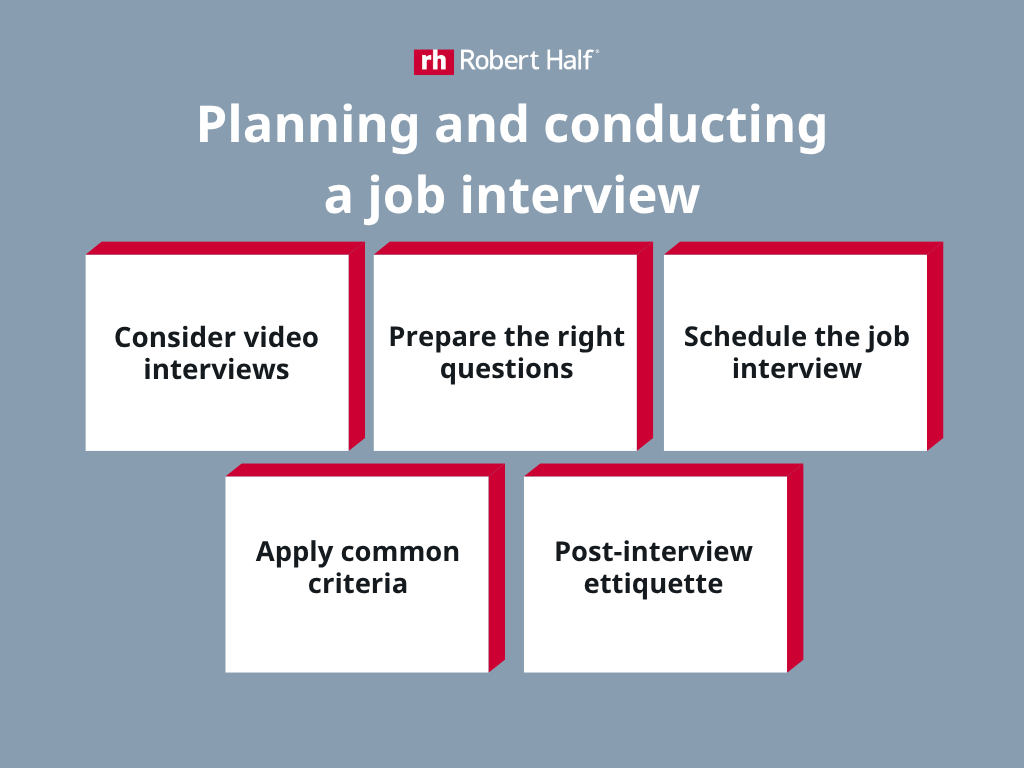
Consider video interviews
Often, you'll end up with an extensive list of suitable candidates but may not have time to meet them all. Travel time can also be a barrier. A phone or video interview can help narrow down your options.
Just speaking with the candidate over the phone can reveal a lot about them. However, video interviews using tools like Teams are growing in popularity because they allow hiring managers to see non-verbal cues.
Prepare the right interview questions
Develop an approach you will use with all candidates. Rank the key factors required for the job in order of importance. Again, let the job ad you created be your guide.
Prior to your video or in-person interview, have a list of questions prepared that explore the key skills necessary to perform the job of each applicant. Include key questions suitable for all candidates, and more specific questions tailored to each candidate's resume. Vary the styles of the questions by including:
Close-ended, factual questions; e.g. “How long did you work for company A?” Open-ended, competency-based questions that require more than a “yes” or “no”-style answer; e.g. “Can you describe three achievements at firm A that you're particularly proud of?” and “Can you tell me about a time when you had to give criticism?” Behavioural/hypothetical questions that relate to situations the candidate is likely to face on the job; e.g. “How would you handle a situation when you are sure your boss is wrong?” and “As a project manager, what would you do to build team spirit?”
Make sure you prepare interview questions for each round of interviews. Asking factual questions in the first interview is more suitable as you want to get to know the candidate and what experience they have. Behavioural questions are more suited to the second and third round of interviews as the candidate will have to deliver concrete evidence to demonstrate they are capable of doing the job.
During each round of the hiring process, make sure each interviewer gives their feedback to every stakeholder involved to avoid doubling up on questions in the second or third interview that were already addressed in the first interview. This will avoid the candidate getting the impression that your company isn’t organised in their post-interview feedback process. Candidates in second or third interviews may consider it unprofessional or a waste of their time if they need to re-state answers to questions already answered in the first interview.
Schedule the job interview
Conducting all in-person interviews over 1 to 2 days will help you get through the interview process faster while ensuring the candidates stay fresh in your mind. Stick to your schedule once you have decided on the interview timeframe. However, be careful not to squeeze too many interviews into the same day, as this could drain you of energy and enthusiasm.
Some ways to accelerate your job interview process include:
Be flexible but organised. Some candidates may find it difficult to be available during normal business hours, so you may need to accommodate them earlier or later in the day. Don't go back and forth trying to find the perfect time, though; if they are serious about the role, they'll find a way to be available.Be strategic. Find the time of day when you're most focused and productive. Aim to conduct interviews for your most promising candidates in that timeslot, when you will be at your 'A' game.Budget enough time. An effective in-person interview will typically be at least 30-40 minutes long, providing sufficient time for both sides to get to know one another. Allocating as much time as you can spare will help you to focus on the candidate, not the clock.
Apply common criteria
Assess each candidate based on the same set of criteria that predict success in your organisation, such as enthusiasm, body language and personality fit. For inspiration, look towards your company's top performing employees for the types of qualities they bring to the job.
See how our Company-IN process helps you define and measure what success looks like in your organisation.
Don’t rush into a judgement
Try to avoid forming an opinion about an applicant too quickly. Wait until after the interview to evaluate the responses and make interpretations.
Read how we helped North Melbourne Football Club tackle unconscious bias.
Take notes
Your memory can play tricks on you, leading you to ignore what actually happened during an interview and rely instead on general impressions. Taking notes helps to avoid this common pitfall. Just make sure you do so unobtrusively so that the interviewees don’t feel like they have to pause for you to keep pace.
Post-interview etiquette
If you still have more candidates to see, tell the interviewee and thank them for their time. To prevent candidates from becoming disinterested, give them frequent updates on the next steps in the interview process. This may involve deciding whether they are needed for a second interview, and if they make your shortlist, speaking to referees. Also don’t forget to notify the candidate if they have not been withheld for the job.
Now that you know how to optimise your job interview practices and reduce the length of the hiring process, you are ready to prepare a shortlist and choose your next star employee.
Looking to hire? Get the right talent to match the skills, experience, and competencies needed for the role. Get in touch with us today.
Frequently Asked Questions (FAQs)
How do you structure different rounds of job interviews?
An organised multi-round interview process should progress from basic facts to deeper competencies:
First Round: Focus on close-ended, factual questions to verify the candidate's resume, experience, and basic alignment with the role. Second and Third Rounds: Use open-ended, behavioural, and hypothetical questions that require candidates to provide concrete evidence of how they handle real-world workplace scenarios.
What are the 7 most common interview questions?
1. "Tell me about yourself."
Why it's asked: To break the ice and gauge how succinctly a candidate can pitch their relevant professional background.
2."What are your greatest strengths?"
Why it's asked: To see if the candidate's core capabilities align with the key requirements of the open role.
3. "What is your biggest weakness?"
Why it's asked: To assess self-awareness, honesty, and whether the candidate is actively working on professional growth.
4. "Why do you want to work for this company?"
Why it's asked: To verify if the candidate has researched the organisation and genuinely cares about the brand, culture, and mission.
5. "Can you describe a challenging workplace situation and how you overcame it?"
Why it's asked: A classic behavioural question designed to evaluate problem-solving abilities, resilience, and conflict resolution skills.
6. "Why are you leaving your current job?"
Why it's asked: To uncover the candidate's motivations—whether they are running toward career growth or running away from a problem.
7. "Where do you see yourself in five years?"
Why it's asked: To understand the applicant's long-term career aspirations and ensure the role aligns with their professional trajectory.
What is the ideal length for a job interview?
An effective, comprehensive job interview should typically last between 30 to 40 minutes. This allows enough time for the hiring manager to thoroughly evaluate skills and for the candidate to ask questions, without draining the interviewer's energy or disrupting the daily schedule.
How should employers evaluate candidates fairly after an interview?
To ensure consistency, assess every applicant against the same predetermined criteria based on the original job description. Avoid making rushed judgments during the meeting. Instead, take unobtrusive notes during the interview and wait until it concludes to objectively score their responses against the qualities demonstrated by your company's top-performing employees.
What is proper post-interview etiquette for employers?
To keep candidates engaged and interested, provide frequent and transparent updates regarding the next steps, such as second-round timelines or reference checks. Once a hiring decision is made, promptly notify unsuccessful applicants rather than leaving them without feedback.
What is the 30-60-90 rule in an interview?
The 30-60-90 rule refers to a strategic plan a candidate presents during an interview outlining what they aim to achieve in their first 90 days on the job. It breaks down their transition into three distinct phases:
Days 1–30 (Focus on Learning): Attending training, mastering company software, understanding internal workflows, and meeting key team members. Days 31–60 (Focus on Contributing): Beginning to handle the core job responsibilities independently, reviewing current processes, and identifying areas for quick wins. Days 61–90 (Focus on Leading/Initiating): Taking full ownership of the role, executing standalone projects, and suggesting strategic solutions to add long-term value.
Presenting a 30-60-90 day plan demonstrates to hiring managers that you are proactive, organised, and already thinking like an employee before you've even been hired.
What are the 5 hardest interview questions?
"Tell me about a time you failed."
This tests accountability; a strong answer will focus on the lesson learned.
"Why should we hire you over others?"
This tests value proposition; a strong answer will focus on the candidate’s unique skill alignment.
"How do you handle conflict?"
This tests emotional intelligence; a strong answer will focus on objective communication.
"What are your salary expectations?"
This tests market research; a strong answer will give a realistic range based on industry benchmarks.
"Why is there a gap in your resume?"
This tests transparency; a strong answer will keep the explanation brief and pivot back to your readiness.